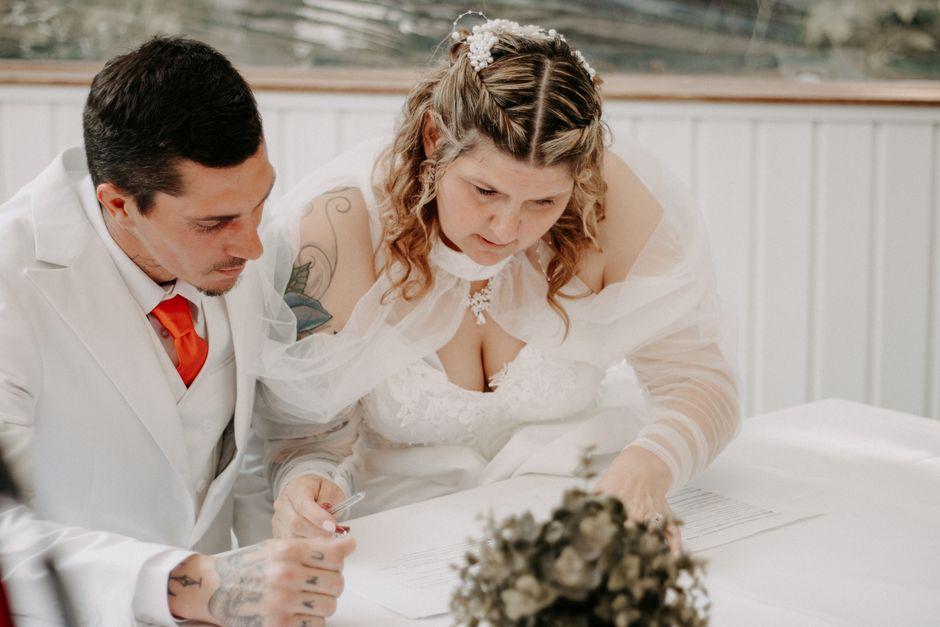
Getting legally married in Maryland takes a license from the circuit court clerk, a ceremony led by someone the law allows, and a signed certificate returned afterward. This guide summarizes the Maryland People's Law Library's guide to Family Law §§ 2-401 to 2-410 and what the county clerks tell couples. Maryland has 24 jurisdictions (23 counties and Baltimore City), each with its own fees and office hours, so check the clerk's page for the county where you will marry.
The short version
- Who issues it: the Clerk of the Circuit Court in the county (or Baltimore City) where the ceremony will take place, wherever you live.
- Only one of you needs to apply in person, with photo ID and proof of age for both of you.
- Waiting period: the license takes effect at 6 a.m. on the second calendar day after it is issued.
- Validity: use it within six months.
- Age: 18 to marry on your own. A 17-year-old needs parental consent and a court order; no one under 17 can marry.
- Fee: set by each county; Queen Anne's and Worcester counties list $35.
- Officiant: an official of a religious group authorized by that group, a judge, or a court clerk or designated deputy clerk.
- After the ceremony: the officiant returns the signed certificate to the issuing clerk within 5 days.
Apply in the county where you will marry
This is the rule that matters most. A Maryland license must come from the circuit court clerk of the county where the wedding will be performed, regardless of where you live, and it is not valid in any other county. Marrying in St. Michaels means Talbot County; Ocean City means Worcester County; Annapolis means Anne Arundel County. If your venue sits near a county line, confirm which county it is in before you apply.
If neither of you lives in that county and a trip to the courthouse is hard to fit in, Maryland lets one of you apply by affidavit instead. You complete a non-resident application-affidavit and swear to it before the official who issues marriage licenses where you live. A notary is not enough. Ask the clerk in the wedding county how long the process takes by mail.
The two-day wait and the six-month window
The license is issued when you apply, but it does not take effect until 6 a.m. on the second calendar day after it is issued. A license issued on a Thursday, for example, can first be used at 6 a.m. on Saturday. A judge can waive the wait in limited cases, but plan around it. The license then stays valid for six months, so most couples apply a few weeks to a couple of months before the wedding.
What to bring
The clerk asks for each person's full legal name, residence, date of birth, place of birth, marital status and Social Security number, which the law requires but which does not appear on the license. You also need photo ID and an official document showing each person's age, such as a birth certificate. If either of you was married before, bring the date and place of the divorce, annulment or death. Maryland does not require a blood test or witnesses.
Age
No one under 17 can marry in Maryland. A 17-year-old can marry only with the consent of each living parent or guardian (or a physician's certificate of pregnancy or birth) and a court order authorizing the marriage, presented to the clerk at least 15 days after it was issued.
Fees and the premarital course discount
Each county sets its fee. Queen Anne's and Worcester counties list $35. Some counties discount the fee for couples who complete a qualifying premarital preparation course within the year before applying (Family Law § 2-404.1), so ask the clerk whether yours does.
Who can perform the ceremony
Under Family Law § 2-406, a Maryland ceremony can be performed by an official of a religious group who is authorized by that group's rules and customs, by a judge, or by a court clerk or a deputy clerk designated by the county's administrative judge. Maryland has no justices of the peace, and its law does not list notaries. For a civil ceremony, the circuit court clerk's office performs them at the courthouse by appointment; Queen Anne's and Worcester counties charge $25. Clerks cannot give legal advice about who else qualifies, so if a friend plans to get ordained to lead your ceremony, check that the ordaining group authorizes its officials to perform marriages. Our Maryland officiant listings are a good place to find someone experienced.
After the ceremony
You receive three copies of the license, which your officiant completes. The officiant must return the signed certificate to the clerk who issued the license within 5 days. Once it is recorded, you can order certified copies from that clerk (Queen Anne's charges $5.50 each), which you will need for a name change.
With the paperwork planned, see Maryland wedding venue types by region and our guide to Chesapeake Bay and Eastern Shore weddings.
This is a plain-language summary, not legal advice. Laws and county procedures change, so confirm current requirements with the circuit court clerk before your wedding.